
The War to Fracture the Core vis a vis the case of Western Tigray
By: Negasi Awetehey
Introduction
After 1991, few elites dissatisfied with the federal system promoted the narrative that Tigray had “annexed lands from Amhara,” a claim later used by the Coalition for Unity and Democracy party ultimately to mobilize the Amhara public particularly Gonder against the EPRDF, federalism, and Tigrayan nationalism. Logically invalid, unconstitutional and politically motivated accusation.
Under Prime Minister Abiy Ahmed, this issue was further politicized and weaponized to brutalize the violence on Tigray. The joint forces carried out ethnic cleansing of Tigrayans in Western Tigray, followed by ongoing demographic changes.
Following the tragedy a farce is followed. The prosperity party is cynically pursuing a strategy of turning parts of Southern Tigray and Western Tigray into permanently contested territories to deepen divisions and undermine the co-equal coexistence of the peoples of the regional states of Amhara and Tigray. The key is to keep Tigray-Amhara enmity alive.
Many have tried to write regarding the administrative and identity history of landscape, especially of the last 400 years. However, neither historical claims nor demographic reality stand in the way of ethnic cleansing as the ethnic cleansing has already been carried out.
In general terms, archaeological and historical sources indicate that Tigray as part of Abyssinia and the modern Ethiopian state has passed through three different phases.
Firstly, Tigray since antiquity (part of the domain of land of the Punt, Damat and Aksumite times) up to the 19th century (Historic Tigray); secondly Tigray from late 19th century-1991 (Provincial Tigray), thirdly Tigray as a semi-sovereign national regional state since 1991 (regional state, Tigray).
While Historic Tigray developed organically, as a project of the Tigrayans themselves largely, Provincial Tigray was the result of ‘de-Tigraying’ projects, through which the Shoa based emperors, sought to disrupt historical continuities by breaking the entity or artificially imposed lines (milashes/borders: e.g. Mereb, tekezze). The rulers were the pioneers of border forgers.
Consequently, the borders imposed—particularly after the reign of Emperor Yohannes IV (1872–1889)—were resisted by Tigrayans. That was why the period of Provincial Tigray was marked by a struggle for self-determination for the Tigrayan people.
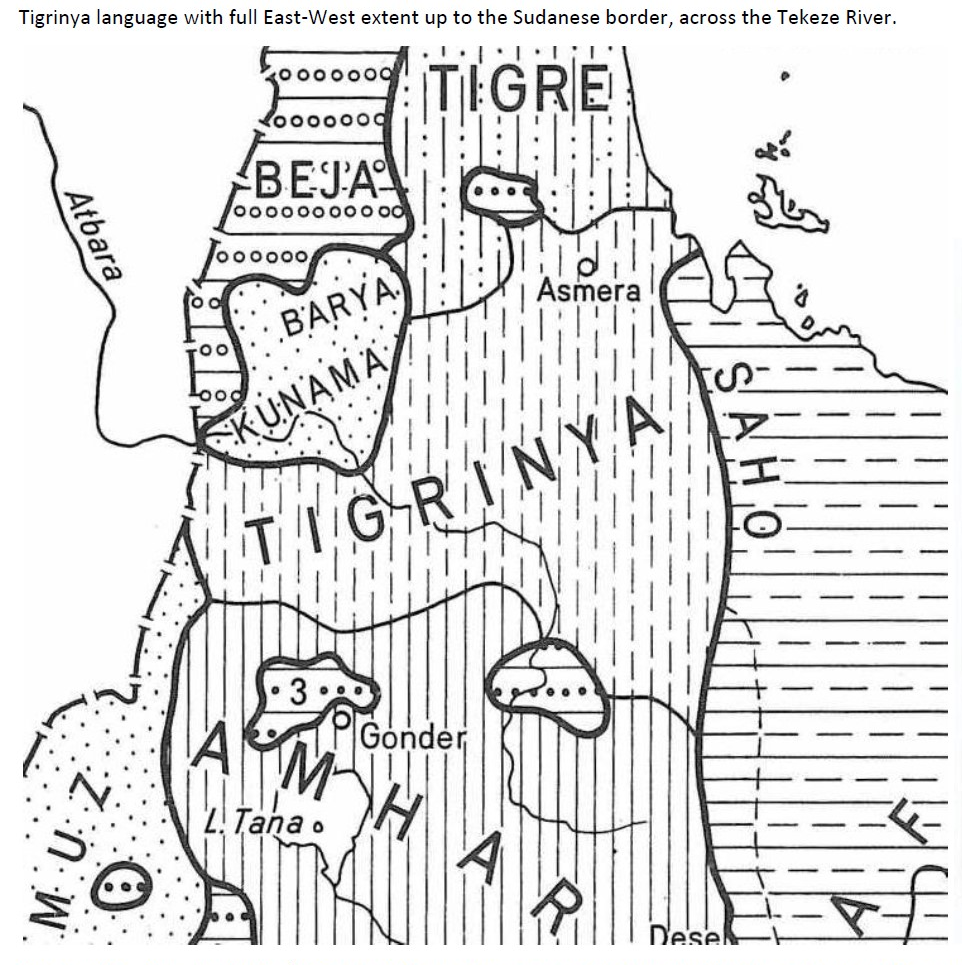
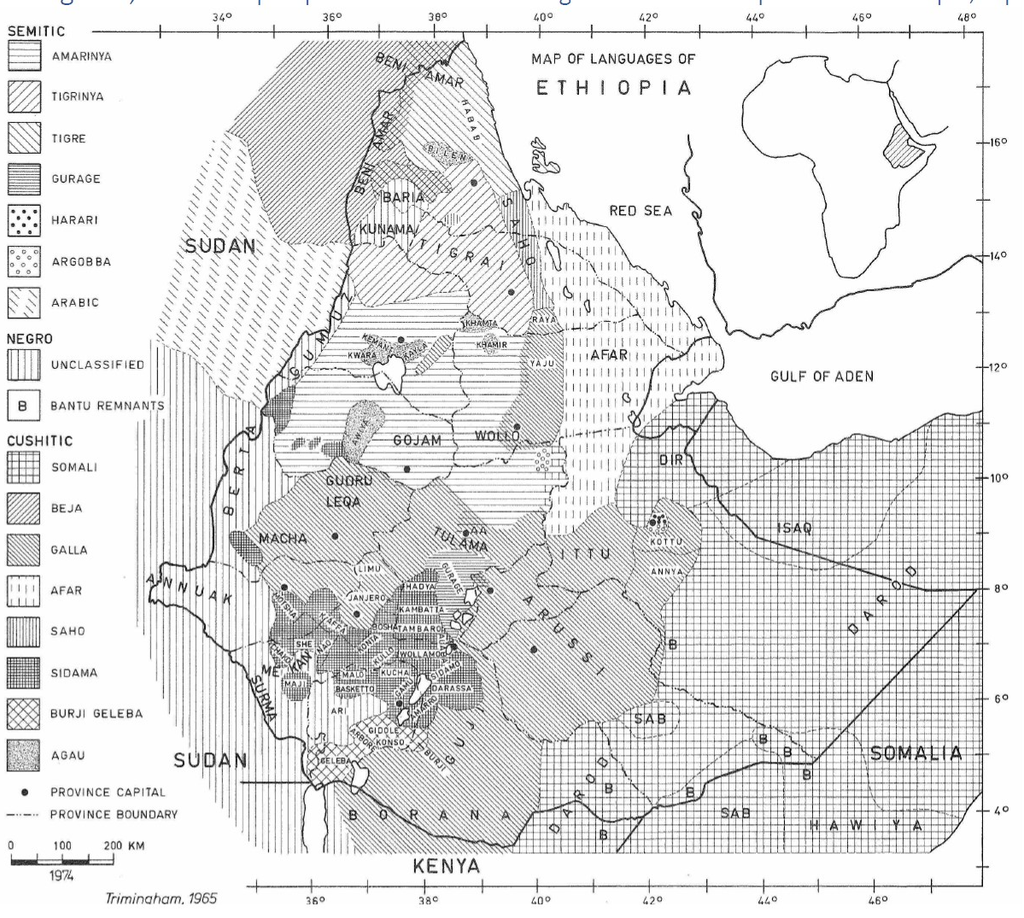
Maps: Tigrinya language with full east-west extent up to the Sudanese border Kuls, 1972 (left) and Trimingham, 1965 (right)
Here, the author first attempts to demonstrate, through metaphors and analogies, how the current regime and its imperial predecessors have sought to territorially fragment Tigray’s core in order to consolidate power. Secondly, the author highlights the antiquity of the area during the pre-Aksumite, Aksumite, and post-Aksumite periods.
Some Metaphors and Analogies
The core, versus knapper and hammer analogy in lithic science captures the conflicting political anatomy of subjugating forces in Addis Ababa and Tigray both in history and now.
Ancient humans using stone as tools had a tough job to remove flakes that could in sequence be flakes or debitages but ultimately make stone tools to be used for resource exploitation or other function. That is, knapping has a predetermined outcome in terms of size, form, and shape.
It is an operational sequence that always has a reducing result on the core. The knapper requires to have a smart knowledge of sourcing as many and/or tougher hammers as s/he can to effectively dismember the core.
In the law of action, the hammer strikes the core while the core is in its mother rock. In the law of reaction, the core, as a stationed matter with its potential energy, resists the hard hammer´s blow. But its resilience naturally depends on the weakness of the hammer.
In history and now; the same methods and intentions have been applied. The law of uniformitarianism that says:
‘’The same laws and processes that operate in our present-day observations have always operated in the past’’ also works.
Tigray (the core) in history has been a victim of de-Tigraying or de-coring projects under the rulers (knappers) and their allies (hammers), and currently, the current regime (a knapper) and its allies (hammers) are aiming to make Tigray a debris where its mode of fracture should not be identified as restorable.
Unfortunately for the knapper (Ethiopian rulers) and hammers (allies), the core (Tigray) has always been stronger and resistant. Hence,
‘’To crush the tough core [resilient but target of decimation and reduction], the hammer must be tougher otherwise, the hammer [which’s sole role is to hit harder] itself shatters first.’’
That is why past Ethiopian rulers leveraged foreign forces (e.g., Menelik II, Italy). Emperor Hailesilasie I (leveraged western powers e.g. it was helped by the British in quashing the first Weyane Rebellion) and continued to knap and flake more and finally consolidate on the graveyard of the preexisting entities. Likewise, today their political descendants invited multiple foreign forces (Eritrea, Somalia, et al.) to change the geography and demography of Tigray.
This knapping sequence involved strategic territorial reduction of the ancient core, Tigray, as a means of bolstering their empire and center. It is, however, anachronistic to mistake that this was with the intent to favor certain people per se Amharas. Ultimately, a nation building at the expense of another pre-existing, semi-autonomous, cohesive and competing entity- Tigray.
Politically speaking, the current irredentists serving the intent of the regime in Addis Ababa border restorers (Amharic: ምላሽ አስመላሾች፡ Milash-(As)melashoch) are descendants of border forgers (Amharic: ምላሽ ፈጣሪዎች፡ Milash-fetariwoch) of the post late 19th-century imperial period.
Reckoning the Chaîne opératoire (operation sequence) of the knapping, Tigrayans sought to legally reconstitute the country and refit the fractured entity. Tigrayans continue to plead their case by invoking the 1995 Constitution and the Pretoria Agreement. The de facto ethnic cleansing, occupation and subsequent resettlement seriously risks that this is not merely a consequence of war, but a deliberate, federally funded political project. Analogous to a stone knapper working towards a predetermined shape, this reflects a deliberate policy of territorial re-engineering.
Pre-Aksumite Period
Archaeological evidence suggests that present-day Western Tigray and nearby regions—including Semien, Metema, Lemalmo, Emba Jewergis, Dabat, and Ras Dejen—formed an important corridor and homeland for pre-Aksumite polities.
Studies of pre-Aksumite archaeology indicate that incense resources in Tigray played a major role in establishing early trade connections with regions across the Red Sea. Western Tigray appears to have been a key source of incense as early as the periods of Punt and Daʿamat, commodities that later remained important in the Aksumite economy.
The first evidence of the existence of elephants was found in Western Tigray at the rock shelter of Ba`ati Gaewa dated around the first millennium BC. Tekle Hagos (2019) documented that the art plausibly suggests the same animal existed around the Tekeze River since Pre-Aksumite times.
Archaeological evidence also points to cultural and trade links between areas west of Aksum and the Sudanese steppes. According to research by George Hatke, obsidian from Tigray may have been exported through trade routes crossing present-day Western Tigray toward Egypt as early as 4000 BC. Rock-art sites distributed across eastern, central, southern, northwestern, and western Tigray—including sites in Tembien, Shire, and Tselemti—further demonstrate the cultural unity of these regions from pre-Aksumite through post-Aksumite times.
The Aksumite Period
During the Aksumite era, Western Tigray remained a home as well as strategic corridor connecting the Aksumite kingdom with Nubia and other regions of the Sudan. The area continued to supply valuable resources such as elephants, ivory, incense, myrrh, gold, frankincense, and possibly sesame. Elephants were especially significant in the Aksumite economy, used for transporting heavy loads, including obelisks, and for military purposes. Their ivory was widely traded overseas which continued until the 19th century and even recently.
The Periplus of the Erythraean Sea indicates that ivory from lands beyond the Tekeze was transported to the Aksumite capital through inland trade routes. The statement from the Periplus of the Erythraean Sea gives two historical facts: western side of Tekeze as source of ivory as well as a home of Aksumite polity:
“ …From that place [Coloe: an inland town and marketplace for ivory along the Red Sea] to the city of the people called Auxumites there is a five days’ journey more; to that place all the ivory is brought from the country beyond the Nile [based on the distance calculation to mean Tekeze, not actual Nile…”
Recent archaeological discoveries, such as the site of Ketema Ra’isi near the Tekezé River, have uncovered fourth-century Aksumite coins. The discoverer of the site mentions it as a promising site, stating “it will provide an archaeological link between the central-western Tigray and the southern lands of Sudan.“ see: P. 463.
These findings reinforce the importance of the region as part of Aksum’s core territory and highlight the Tekezé River’s role as a route linking central-western Tigray with regions further south toward Sudan.
Indigenous Communities
The Kunama people, who today live in northwestern and western Tigray, are considered among the region’s oldest inhabitants. Early written references to the Kunama in the areas appear in the accounts of Arab travelers such as al-Yaʿqubi (9th century) and Ibn Hawqal (10th century).
Local traditions in areas such as Sheraro, Addi Goshu and Humera connect their history to the Aksumite king Bazen (Baden) and his wife Kuname, suggesting a long-standing presence dating back to the pre-Aksumite and Aksumite periods.
Welkait and Semien
Aksumite inscriptions from the fourth century, including those of King Ezana and King Ella Amida, indicate that the inhabitants of Semien paid tribute to the Aksumite rulers, suggesting their inclusion within the political domain of the Aksumite polity.
Furthermore, the Aksumite inscription from Adulis known from the report by Cosmas Indicopleustes’ book Christian Topography mentions a mountain covered with snow (snow-covered). As a traveler he came with an itinerary to visit the kingdom and visited the capital and its domains too (Simien). Historical evidence indicates that this mountain was either the mountain chains of Lemalmo or Mt. Ras Dashen, i.e, the highest peak in the territory.
As a continuation of the history above, Lemalmo, and Semen or Simien are mentioned by a Jesuit Missionary from Portugal, Emanuel Baradas, as the borders of Tigray in the early 17th century. Let’s also see linguistic evidence below.
The linguistic evidence in the preamble of versi abissini (ቅኔ፡ሓበሻ) by Jacques Faitlovich (1910):
“Tigrinya had been in use in a large part of Semien and in the whole of the Tselemti province up to the Dibba-Baher district, at the foot of the Lemalmon pass that forms its border to Wogara“ also confirms.
James Bruce`s 18th century manuscript named as “MS Bruce 94“ states Welkait and its surrounding had Tigrinya-speaking Bete Israelite inhabitants:
“in regions to the north and east of Gondär, namely Wälqayǝt, Ṭsägäde, Ṭsällämti, and Wag Hǝmra they [Bete Israel people] spoke Tigrinya…“(Dege-Müller: 2020: 14).
The Bete Israelites associate their history to the history of the Ark of the Covenant, Pre-Aksumite times, 930 BC. There is the same community in the current northwestern Tigray too.
According to versi abissini (ቅኔ፡ ሓበሻ) by Jacques Faitlovich historically, in the 19th century Tigrigna used to dominate a larger territory:
“Tigrigna, Tigrinya or Tigrai, a language spoken…throughout the entire northern part of the Negus empire, on this side of the Tekazzé and on the other side of this river in the western provinces, in Tsegdie, Wolqaït, Waldebba and in a part of Tselemt. “
Negasi Awetehey is a member of the Department of Archaeology and Heritage Management at Aksum University. He is currently pursuing his Ph.D. at the University of Geneva. He can be reached at: negasiawetehey@gmail.com.


